AI Agents and the Next Wave of Onchain Demand
By
José Sanchez, Kelvin Koh
Apr 17, 2026
When Virtuals Protocol launched Luna in late 2024 and GOAT token briefly exceeded $850 million in market cap, AI agents in crypto were a cultural moment: sentiment-driven tokens, viral personas, speculative communities. The infrastructure question being asked today is a different one. Not whether agents can capture attention, but whether they can hold a wallet, pay for a service, and complete a task without a human in the loop. Over the past three months, a wave of protocol launches and standard deployments have begun to provide a concrete answer, one that is actively being built in production.
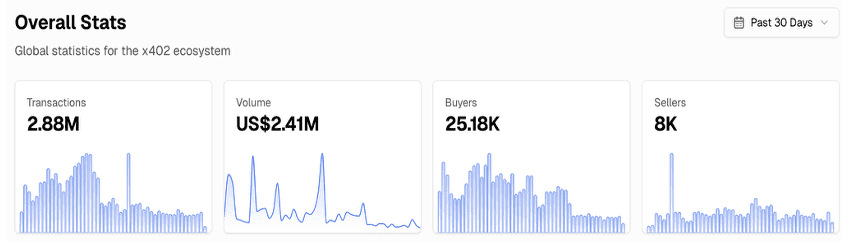
The underlying problem is straightforward. AI agents are autonomous software that can write code, coordinate workflow, retrieve data, and execute complex multi-step tasks. What they cannot do is open a bank account. Banks require identity verification that software cannot provide, and no identity verification process exists that an automated system can complete on its own. On March 9, Coinbase CEO Brian Armstrong made this point directly: "Very soon there are going to be more AI agents than humans making transactions. They can't open a bank account, but they can own a crypto wallet." Coinbase has already acted on this logic. On February 11, it launched Agentic Wallets built on its x402 protocol, providing wallet infrastructure specifically for agents. These wallets are generated from private keys, can be funded in minutes, and are capable of gasless trading on Base with no identity requirement. In the past 30 days, x402 processed 2.88 million transactions totaling $2.41 million in volume, averaging $0.83 per transaction. Small amounts, high frequency: exactly what the protocol was built for.
Coinbase's Agentic Wallets have shown some early activity
Source: x402scan
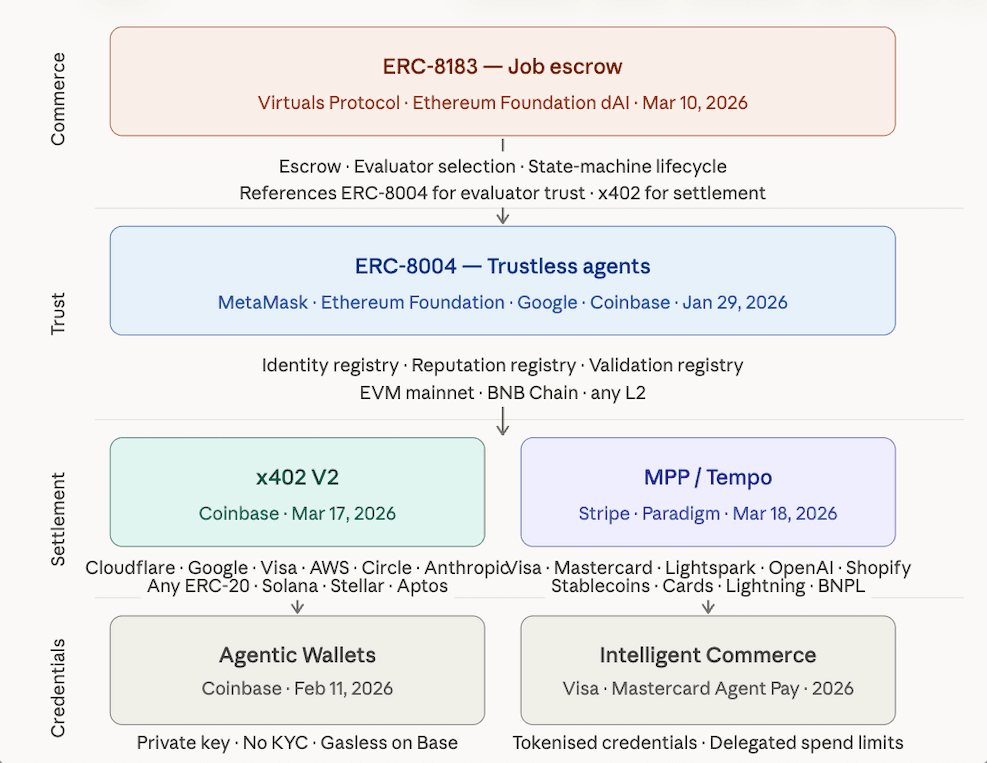
The payments problem is only half of the infrastructure gap. Before an agent can pay another agent, it needs to know who it is paying and whether that counterparty can be trusted. This is the problem ERC-8004 tackles. Proposed in August 2025 by contributors from MetaMask, the Ethereum Foundation, Google, and Coinbase, and deployed to Ethereum mainnet on January 29, 2026, the standard defines three lightweight on-chain registries for autonomous agents. The Identity Registry assigns each agent a unique on-chain identifier resolving to a profile of its capabilities and payment address. The Reputation Registry allows any client, human or machine, to post structured feedback against that identity over time. The Validation Registry provides hooks for independent third-party verification of task outputs for higher-stakes interactions. ERC-8004 does not handle payments or business logic. It is the discovery and trust layer that sits beneath them.
The third piece of the stack is structured commerce. ERC-8183, jointly proposed by Virtuals Protocol and the Ethereum Foundation's dAI team on March 10, defines the Job primitive: the atomic unit of agentic commerce. A client must deposit the full budget into on-chain escrow before work begins, with funds locked before a single step is executed. An Evaluator, selected on the basis of ERC-8004 reputation records, is the only party authorized to call completion or rejection once work is submitted. Rather than requiring counterparties to trust each other upfront, the structure makes the transaction robust to defection by either side.
At the settlement layer, two protocols emerged within a day of each other in mid-March. Coinbase's x402, originally launched in May 2025, revives HTTP status code 402, a placeholder in the web's specifications since 1996 that was never implemented. An agent requests a resource, the server responds with payment instructions, the agent pays, the server delivers. No accounts, no API keys. The payment is the credential. x402 peaked at over 600,000 daily transactions on Base in December, representing 19% of all Base network activity at that point, before normalizing to around 100,000 daily transactions. On March 17, Coinbase released x402 V2 with full ERC-20 token support and an MCP Toolkit for monetizing AI tools with a single integration. The x402 Foundation now includes Coinbase, Cloudflare, Google, Visa, AWS, Circle, and Anthropic.
One day later, Stripe and Paradigm launched Tempo mainnet alongside the Machine Payments Protocol (MPP). Where x402 settles each request as a discrete on-chain transaction, MPP introduces sessions: persistent payment channels where an agent deposits funds into escrow and signs cumulative cryptographic vouchers as it consumes resources, batching thousands of micro-interactions into a single settlement. The protocol is deliberately rail-agnostic. Visa extended it to card-based payments, Stripe bridged it to traditional rails through programmable time-limited authorizations, and the result is a settlement layer that spans stablecoins, cards, and legacy payment infrastructure within a single protocol. MPP launched with integrations across more than 100 services, with design partners spanning Mastercard, Shopify, Revolut, and Standard Chartered Bank.
The two protocols serve different segments, and that distinction matters. x402 is stateless, permissionless, and zero-fee, suited to the long tail of independent APIs and micropayment-gated content. MPP is stateful and enterprise-oriented, built for compliance-heavy workloads where fiat payment paths and audit trails are non-negotiable. Visa joining the x402 Foundation while simultaneously co-authoring the MPP card specification is the clearest signal that this is not a winner-takes-all race but a multi-rail ecosystem built to operate across different trust and compliance requirements.
Agentic infrastructure stack comprises multiple layers
Source: Spartan Capital
A complete agentic transaction across this stack might flow as follows: a client agent queries ERC-8004 to discover and filter service providers by reputation, locks budget via an ERC-8183 job escrow with an evaluator drawn from the reputation registry, consumes the service, and settles via x402 or MPP depending on the compliance requirements of the counterparty. No single team has built this end-to-end yet, but the standards cross-reference each other deliberately, and the infrastructure investment from Coinbase, Stripe, Visa, and the Ethereum Foundation is arriving in a compressed window.
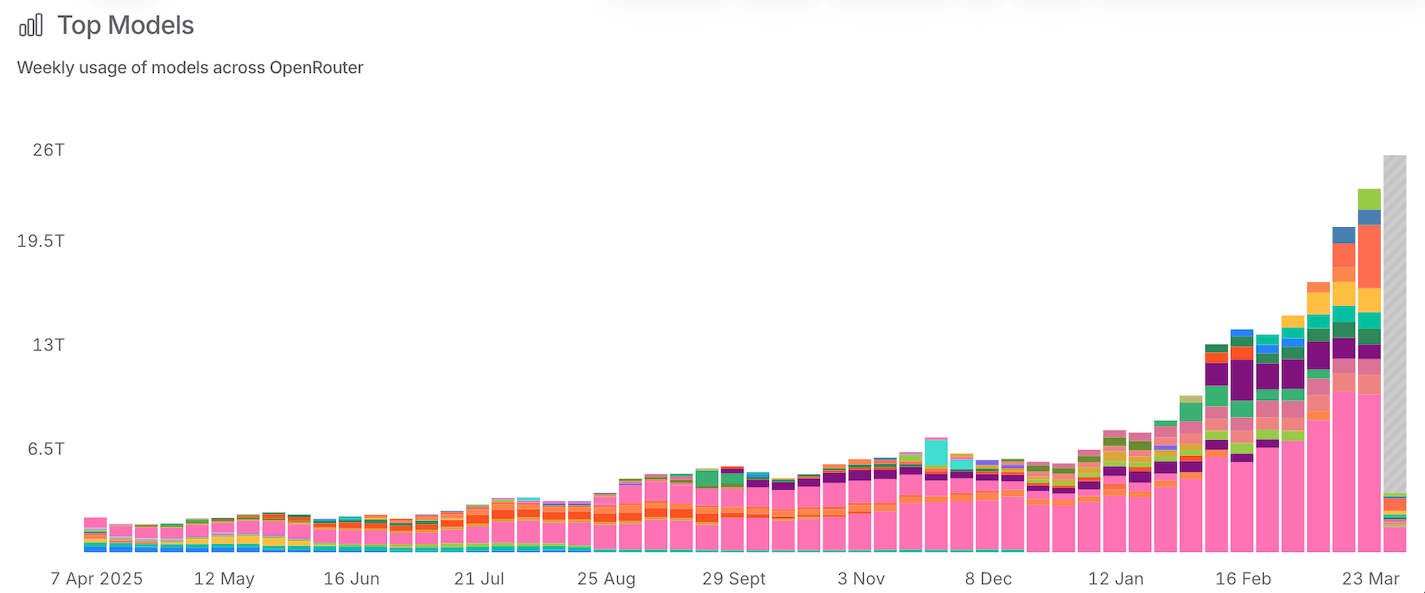
The current transaction volumes are unimpressive, and that is the point. The case for this infrastructure is not the numbers today but what happens to blockspace demand as inference activity continues its current trajectory. Weekly token usage across OpenRouter has grown from roughly 1.5 trillion tokens per week in April 2025 to over 26 trillion by late March 2026, nearly a 17x increase in under a year. That growth is accelerating, not flattening.
Source: OpenRouter
Each of those tokens represents a model call. As agentic inference grows as a share of that total, each session generates not one API call but dozens: tool invocations, data retrievals, service requests, many of which will require payment. Which chain ultimately captures the bulk of this activity is genuinely unclear. Off-chain batching approaches like Circle's nano-payments bundle thousands of transfers into a single settlement, which could absorb volume without generating proportional blockspace demand. However, Solana's 2024 experience is instructive: for years, fees were so low that material fee revenue seemed structurally impossible, until the memecoin wave that year proved otherwise, briefly pushing the network to congestion nobody had modelled.
Today's blockchains process tens of millions of daily transactions driven primarily by DeFi, stablecoin transfers, and speculative activity. Agent-driven activity is a different kind of demand, but if transaction counts expand dramatically enough, even batched settlement generates meaningful on-chain volume. The mental model that matters is not whether crypto captures AI payments. It is what happens to blockspace demand if even a small percentage of machine-to-machine activity settles on-chain.
What is clear is the direction. Coinbase, Stripe, Cloudflare, Google, Visa, Mastercard, Anthropic, and the Ethereum Foundation are all building toward the same endpoint: a web where machines pay machines without human intermediation. The protocols are early. The volumes are small. But the stack is assembling faster than most realize, and the underlying demand curve is not waiting for it to be ready.
When Virtuals Protocol launched Luna in late 2024 and GOAT token briefly exceeded $850 million in market cap, AI agents in crypto were a cultural moment: sentiment-driven tokens, viral personas, speculative communities. The infrastructure question being asked today is a different one. Not whether agents can capture attention, but whether they can hold a wallet, pay for a service, and complete a task without a human in the loop. Over the past three months, a wave of protocol launches and standard deployments have begun to provide a concrete answer, one that is actively being built in production.
The underlying problem is straightforward. AI agents are autonomous software that can write code, coordinate workflow, retrieve data, and execute complex multi-step tasks. What they cannot do is open a bank account. Banks require identity verification that software cannot provide, and no identity verification process exists that an automated system can complete on its own. On March 9, Coinbase CEO Brian Armstrong made this point directly: "Very soon there are going to be more AI agents than humans making transactions. They can't open a bank account, but they can own a crypto wallet." Coinbase has already acted on this logic. On February 11, it launched Agentic Wallets built on its x402 protocol, providing wallet infrastructure specifically for agents. These wallets are generated from private keys, can be funded in minutes, and are capable of gasless trading on Base with no identity requirement. In the past 30 days, x402 processed 2.88 million transactions totaling $2.41 million in volume, averaging $0.83 per transaction. Small amounts, high frequency: exactly what the protocol was built for.
Coinbase's Agentic Wallets have shown some early activity
Source: x402scan
The payments problem is only half of the infrastructure gap. Before an agent can pay another agent, it needs to know who it is paying and whether that counterparty can be trusted. This is the problem ERC-8004 tackles. Proposed in August 2025 by contributors from MetaMask, the Ethereum Foundation, Google, and Coinbase, and deployed to Ethereum mainnet on January 29, 2026, the standard defines three lightweight on-chain registries for autonomous agents. The Identity Registry assigns each agent a unique on-chain identifier resolving to a profile of its capabilities and payment address. The Reputation Registry allows any client, human or machine, to post structured feedback against that identity over time. The Validation Registry provides hooks for independent third-party verification of task outputs for higher-stakes interactions. ERC-8004 does not handle payments or business logic. It is the discovery and trust layer that sits beneath them.
The third piece of the stack is structured commerce. ERC-8183, jointly proposed by Virtuals Protocol and the Ethereum Foundation's dAI team on March 10, defines the Job primitive: the atomic unit of agentic commerce. A client must deposit the full budget into on-chain escrow before work begins, with funds locked before a single step is executed. An Evaluator, selected on the basis of ERC-8004 reputation records, is the only party authorized to call completion or rejection once work is submitted. Rather than requiring counterparties to trust each other upfront, the structure makes the transaction robust to defection by either side.
At the settlement layer, two protocols emerged within a day of each other in mid-March. Coinbase's x402, originally launched in May 2025, revives HTTP status code 402, a placeholder in the web's specifications since 1996 that was never implemented. An agent requests a resource, the server responds with payment instructions, the agent pays, the server delivers. No accounts, no API keys. The payment is the credential. x402 peaked at over 600,000 daily transactions on Base in December, representing 19% of all Base network activity at that point, before normalizing to around 100,000 daily transactions. On March 17, Coinbase released x402 V2 with full ERC-20 token support and an MCP Toolkit for monetizing AI tools with a single integration. The x402 Foundation now includes Coinbase, Cloudflare, Google, Visa, AWS, Circle, and Anthropic.
One day later, Stripe and Paradigm launched Tempo mainnet alongside the Machine Payments Protocol (MPP). Where x402 settles each request as a discrete on-chain transaction, MPP introduces sessions: persistent payment channels where an agent deposits funds into escrow and signs cumulative cryptographic vouchers as it consumes resources, batching thousands of micro-interactions into a single settlement. The protocol is deliberately rail-agnostic. Visa extended it to card-based payments, Stripe bridged it to traditional rails through programmable time-limited authorizations, and the result is a settlement layer that spans stablecoins, cards, and legacy payment infrastructure within a single protocol. MPP launched with integrations across more than 100 services, with design partners spanning Mastercard, Shopify, Revolut, and Standard Chartered Bank.
The two protocols serve different segments, and that distinction matters. x402 is stateless, permissionless, and zero-fee, suited to the long tail of independent APIs and micropayment-gated content. MPP is stateful and enterprise-oriented, built for compliance-heavy workloads where fiat payment paths and audit trails are non-negotiable. Visa joining the x402 Foundation while simultaneously co-authoring the MPP card specification is the clearest signal that this is not a winner-takes-all race but a multi-rail ecosystem built to operate across different trust and compliance requirements.
Agentic infrastructure stack comprises multiple layers
Source: Spartan Capital
A complete agentic transaction across this stack might flow as follows: a client agent queries ERC-8004 to discover and filter service providers by reputation, locks budget via an ERC-8183 job escrow with an evaluator drawn from the reputation registry, consumes the service, and settles via x402 or MPP depending on the compliance requirements of the counterparty. No single team has built this end-to-end yet, but the standards cross-reference each other deliberately, and the infrastructure investment from Coinbase, Stripe, Visa, and the Ethereum Foundation is arriving in a compressed window.
The current transaction volumes are unimpressive, and that is the point. The case for this infrastructure is not the numbers today but what happens to blockspace demand as inference activity continues its current trajectory. Weekly token usage across OpenRouter has grown from roughly 1.5 trillion tokens per week in April 2025 to over 26 trillion by late March 2026, nearly a 17x increase in under a year. That growth is accelerating, not flattening.
Source: OpenRouter
Each of those tokens represents a model call. As agentic inference grows as a share of that total, each session generates not one API call but dozens: tool invocations, data retrievals, service requests, many of which will require payment. Which chain ultimately captures the bulk of this activity is genuinely unclear. Off-chain batching approaches like Circle's nano-payments bundle thousands of transfers into a single settlement, which could absorb volume without generating proportional blockspace demand. However, Solana's 2024 experience is instructive: for years, fees were so low that material fee revenue seemed structurally impossible, until the memecoin wave that year proved otherwise, briefly pushing the network to congestion nobody had modelled.
Today's blockchains process tens of millions of daily transactions driven primarily by DeFi, stablecoin transfers, and speculative activity. Agent-driven activity is a different kind of demand, but if transaction counts expand dramatically enough, even batched settlement generates meaningful on-chain volume. The mental model that matters is not whether crypto captures AI payments. It is what happens to blockspace demand if even a small percentage of machine-to-machine activity settles on-chain.
What is clear is the direction. Coinbase, Stripe, Cloudflare, Google, Visa, Mastercard, Anthropic, and the Ethereum Foundation are all building toward the same endpoint: a web where machines pay machines without human intermediation. The protocols are early. The volumes are small. But the stack is assembling faster than most realize, and the underlying demand curve is not waiting for it to be ready.
To learn more about investment opportunities with Spartan Capital, please contact ir@spartangroup.io
