DeFi's Institutional Inflection Point
By
José Sanchez, Kelvin Koh
Mar 17, 2026
A remarkable concentration of institutional-crypto partnerships emerged over a single week in February 2026, marking what we believe is a qualitative shift in how traditional finance engages with onchain infrastructure. Within five days, Citadel Securities announced its investment in LayerZero’s ZRO token; BlackRock listed its $2.5 billion BUIDL fund on UniswapX and purchased UNI tokens; and Apollo Global Management committed to acquiring up to 9% of Morpho’s governance token supply over four years. These followed the NYSE’s January 19 unveiling of a tokenized securities platform designed for 24/7 onchain settlement. The pattern is clear: institutional capital is moving from exploration to actual onchain execution: purchasing tokens, taking governance stakes, and routing products through decentralized infrastructure.
Three aspects distinguish this wave from prior cycles. First, these are direct token purchases creating economic alignment, not advisory arrangements or pilot announcements. Second, the products involved are live and revenue-generating: BUIDL manages $2.5 billion, Morpho supports $900 million in active Coinbase loans, LayerZero has settled $70 billion in USDT0 transfers. Third, institutions are choosing public, permissionless protocols over proprietary walled gardens, signalling that the composability and network effects of existing DeFi infrastructure are more valuable than the control offered by bespoke systems.
The NYSE set the stage on January 19, announcing plans for a blockchain-based venue supporting 24/7 trading and instant onchain settlement of tokenized equities and ETFs, combining its Pillar matching engine with blockchain post-trade systems. While still pending regulatory approval and light on implementation details, this is a directional signal of the first order: the world’s most iconic stock exchange committing to onchain settlement as core infrastructure.
LayerZero followed on February 10 with the unveiling of Zero, a new Layer 1 designed as institutional-grade financial infrastructure. Citadel Securities made a strategic ZRO token purchase, notable for a firm handling approximately 35% of US retail stock trades. DTCC will explore Zero for scaling its tokenization and collateral management; ICE is evaluating the chain for 24/7 trading infrastructure; Google Cloud joined to explore AI agent micropayments; and ARK Invest took both equity and token positions, with Cathie Wood joining the advisory board. Tether also announced a separate strategic investment in LayerZero Labs on the same day. Zero is expected to launch in fall 2026 with three zones: a general-purpose EVM environment, privacy-focused payments, and a purpose-built trading zone.
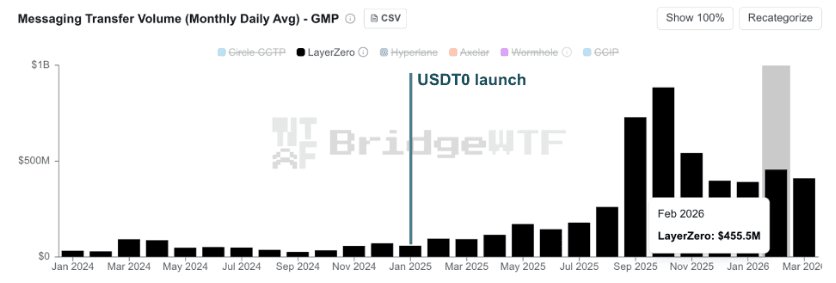
The institutional interest reflects proven throughput. USDT0, Tether’s omnichain stablecoin built on LayerZero’s OFT standard, has facilitated over $70 billion in cross-chain transfers since January 2025. As the chart below shows, daily settlement value accelerated dramatically post-USDT0, transforming LayerZero from a messaging layer into critical financial infrastructure.
USDT0 has facilitated over $70 billion in cross-chain transfers since launch
Source: BridgeWTF
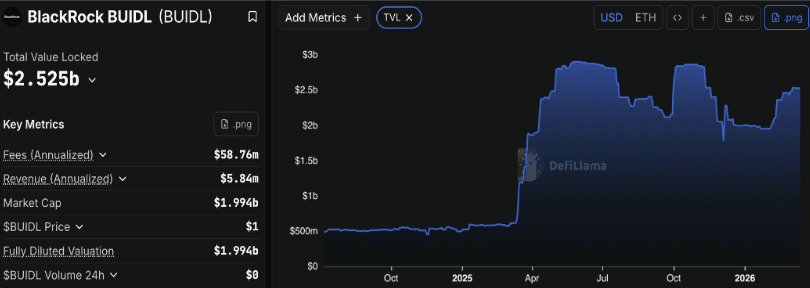
The following day, BlackRock’s $2.4 billion BUIDL fund, the largest tokenized US Treasury product, became tradable on UniswapX, the first time a BlackRock product has been accessible through decentralized exchange infrastructure. Securitize handles compliance and whitelisting, while Wintermute, Flowdesk, and Tokka Labs compete via UniswapX’s RFQ framework. BlackRock also disclosed a strategic UNI token purchase (although deal terms haven’t been shared yet), the first DeFi governance token on its balance sheet. While BUIDL access remains limited to qualified purchasers with $5 million minimums, Securitize CEO Carlos Domingo noted the infrastructure is designed to scale to retail products over time. The decision to list on Uniswap reflects BUIDL’s trajectory from niche experiment to institutional-scale product. Since launching in March 2024 at $40 million, the fund peaked near $2.9 billion in mid-2025 and is currently sitting at $2.5 billion TVL.
Blackrock’s BUIDL Fund is now at $2.5 billion TVL
Source: Defillama
On February 13, Apollo Global Management signed a cooperation agreement to acquire up to 90 million MORPHO tokens, approximately 9% of total supply, over 48 months. Beyond the token acquisition (valued at $110 million at mid-February prices), Apollo will collaborate on building onchain lending markets, extending a blockchain footprint where some of its credit strategies are already tokenized via Securitize (ACRED) and Anemoy (ACRDX). The deal represents one of the most significant institutional engagements with a DeFi-native protocol to date.
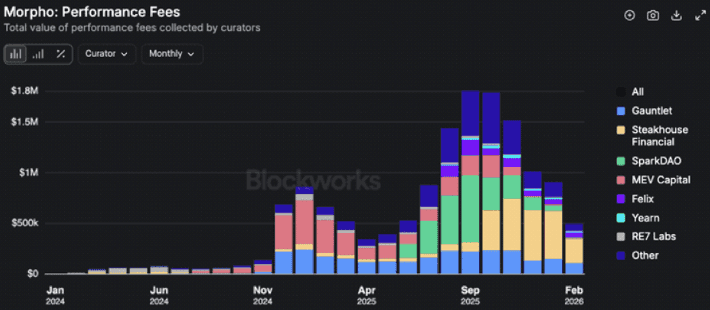
The institutional opportunity within Morpho extends beyond token ownership. The protocol’s architecture allows any entity to become a vault curator, constructing lending markets with bespoke risk parameters. Curators earn performance fees on yield generated and management fees on AUM (capped at 5%), creating a recurring revenue model for institutional participants.
Perhaps the most compelling validation of this infrastructure is the CeFi–DeFi “mullet” pioneered by Coinbase: retail users borrow against BTC and ETH through the Coinbase interface, while Morpho operates as the backend lending engine, currently supporting over $900 million in active loans and $1.7 billion in collateral. This demonstrates that institutional-grade DeFi can be abstracted behind familiar consumer interfaces at scale, without users interacting with the underlying protocol. For Apollo, the combination of vault curation economics, Coinbase validated distribution, and governance influence via token accumulation creates a compelling position in onchain credit.
The convergence validates the design choices of permissionless, composable protocols and suggests sustained demand for governance tokens of infrastructure layer projects. The key risk remains execution: regulatory approvals are pending for the NYSE platform and Zero, institutional token purchases may test protocol governance, and the gap between announcement and sustained onchain activity is still wide. Nevertheless, the directional signal is unmistakable.
Morpho vault curators have generated a healthy amount of fees
Source: Blockworks Research
Looking ahead, we expect these partnerships to deepen once the CLARITY Act achieves passage. The bill cleared the House in July 2025 (294–134) and is moving through the Senate, where the Banking and Agriculture Committees must reconcile drafts before a floor vote. The key sticking point is stablecoin yield treatment, with banks pushing to restrict interest on stablecoin balances while crypto firms argue this would push innovation offshore. July is widely cited as the critical deadline before the August recess; if missed, the next window shifts to the fall. Once enacted, the CLARITY Act would provide the first comprehensive US digital asset framework, clarifying SEC/CFTC jurisdiction, establishing registration pathways for digital commodity exchanges, and creating legal certainty around tokenized products. For protocols like Morpho and Uniswap, this would remove the regulatory ambiguity that currently constrains the scope of institutional partnerships. We believe it would unlock a second, broader wave of TradFi–crypto integration.
A remarkable concentration of institutional-crypto partnerships emerged over a single week in February 2026, marking what we believe is a qualitative shift in how traditional finance engages with onchain infrastructure. Within five days, Citadel Securities announced its investment in LayerZero’s ZRO token; BlackRock listed its $2.5 billion BUIDL fund on UniswapX and purchased UNI tokens; and Apollo Global Management committed to acquiring up to 9% of Morpho’s governance token supply over four years. These followed the NYSE’s January 19 unveiling of a tokenized securities platform designed for 24/7 onchain settlement. The pattern is clear: institutional capital is moving from exploration to actual onchain execution: purchasing tokens, taking governance stakes, and routing products through decentralized infrastructure.
Three aspects distinguish this wave from prior cycles. First, these are direct token purchases creating economic alignment, not advisory arrangements or pilot announcements. Second, the products involved are live and revenue-generating: BUIDL manages $2.5 billion, Morpho supports $900 million in active Coinbase loans, LayerZero has settled $70 billion in USDT0 transfers. Third, institutions are choosing public, permissionless protocols over proprietary walled gardens, signalling that the composability and network effects of existing DeFi infrastructure are more valuable than the control offered by bespoke systems.
The NYSE set the stage on January 19, announcing plans for a blockchain-based venue supporting 24/7 trading and instant onchain settlement of tokenized equities and ETFs, combining its Pillar matching engine with blockchain post-trade systems. While still pending regulatory approval and light on implementation details, this is a directional signal of the first order: the world’s most iconic stock exchange committing to onchain settlement as core infrastructure.
LayerZero followed on February 10 with the unveiling of Zero, a new Layer 1 designed as institutional-grade financial infrastructure. Citadel Securities made a strategic ZRO token purchase, notable for a firm handling approximately 35% of US retail stock trades. DTCC will explore Zero for scaling its tokenization and collateral management; ICE is evaluating the chain for 24/7 trading infrastructure; Google Cloud joined to explore AI agent micropayments; and ARK Invest took both equity and token positions, with Cathie Wood joining the advisory board. Tether also announced a separate strategic investment in LayerZero Labs on the same day. Zero is expected to launch in fall 2026 with three zones: a general-purpose EVM environment, privacy-focused payments, and a purpose-built trading zone.
The institutional interest reflects proven throughput. USDT0, Tether’s omnichain stablecoin built on LayerZero’s OFT standard, has facilitated over $70 billion in cross-chain transfers since January 2025. As the chart below shows, daily settlement value accelerated dramatically post-USDT0, transforming LayerZero from a messaging layer into critical financial infrastructure.
USDT0 has facilitated over $70 billion in cross-chain transfers since launch
Source: BridgeWTF
The following day, BlackRock’s $2.4 billion BUIDL fund, the largest tokenized US Treasury product, became tradable on UniswapX, the first time a BlackRock product has been accessible through decentralized exchange infrastructure. Securitize handles compliance and whitelisting, while Wintermute, Flowdesk, and Tokka Labs compete via UniswapX’s RFQ framework. BlackRock also disclosed a strategic UNI token purchase (although deal terms haven’t been shared yet), the first DeFi governance token on its balance sheet. While BUIDL access remains limited to qualified purchasers with $5 million minimums, Securitize CEO Carlos Domingo noted the infrastructure is designed to scale to retail products over time. The decision to list on Uniswap reflects BUIDL’s trajectory from niche experiment to institutional-scale product. Since launching in March 2024 at $40 million, the fund peaked near $2.9 billion in mid-2025 and is currently sitting at $2.5 billion TVL.
Blackrock’s BUIDL Fund is now at $2.5 billion TVL
Source: Defillama
On February 13, Apollo Global Management signed a cooperation agreement to acquire up to 90 million MORPHO tokens, approximately 9% of total supply, over 48 months. Beyond the token acquisition (valued at $110 million at mid-February prices), Apollo will collaborate on building onchain lending markets, extending a blockchain footprint where some of its credit strategies are already tokenized via Securitize (ACRED) and Anemoy (ACRDX). The deal represents one of the most significant institutional engagements with a DeFi-native protocol to date.
The institutional opportunity within Morpho extends beyond token ownership. The protocol’s architecture allows any entity to become a vault curator, constructing lending markets with bespoke risk parameters. Curators earn performance fees on yield generated and management fees on AUM (capped at 5%), creating a recurring revenue model for institutional participants.
Perhaps the most compelling validation of this infrastructure is the CeFi–DeFi “mullet” pioneered by Coinbase: retail users borrow against BTC and ETH through the Coinbase interface, while Morpho operates as the backend lending engine, currently supporting over $900 million in active loans and $1.7 billion in collateral. This demonstrates that institutional-grade DeFi can be abstracted behind familiar consumer interfaces at scale, without users interacting with the underlying protocol. For Apollo, the combination of vault curation economics, Coinbase validated distribution, and governance influence via token accumulation creates a compelling position in onchain credit.
The convergence validates the design choices of permissionless, composable protocols and suggests sustained demand for governance tokens of infrastructure layer projects. The key risk remains execution: regulatory approvals are pending for the NYSE platform and Zero, institutional token purchases may test protocol governance, and the gap between announcement and sustained onchain activity is still wide. Nevertheless, the directional signal is unmistakable.
Morpho vault curators have generated a healthy amount of fees
Source: Blockworks Research
Looking ahead, we expect these partnerships to deepen once the CLARITY Act achieves passage. The bill cleared the House in July 2025 (294–134) and is moving through the Senate, where the Banking and Agriculture Committees must reconcile drafts before a floor vote. The key sticking point is stablecoin yield treatment, with banks pushing to restrict interest on stablecoin balances while crypto firms argue this would push innovation offshore. July is widely cited as the critical deadline before the August recess; if missed, the next window shifts to the fall. Once enacted, the CLARITY Act would provide the first comprehensive US digital asset framework, clarifying SEC/CFTC jurisdiction, establishing registration pathways for digital commodity exchanges, and creating legal certainty around tokenized products. For protocols like Morpho and Uniswap, this would remove the regulatory ambiguity that currently constrains the scope of institutional partnerships. We believe it would unlock a second, broader wave of TradFi–crypto integration.
To learn more about investment opportunities with Spartan Capital, please contact ir@spartangroup.io
