Robinhood Chain: Earn, Launchpads and Stock Tokens
By
José Sanchez, Kelvin Koh
Sep 15, 2026
Robinhood Chain went live on mainnet on July 1, 2026, a permissionless, EVM-compatible Layer 2 built on Arbitrum Orbit and settling to Ethereum, with ETH as gas and 100 millisecond blocks. Two protocols were live from day one and define what the chain does: Uniswap, the chain's main liquidity venue, and Morpho, which powers Robinhood Earn, the lending product launched with it. The pitch to developers was distribution: Robinhood has 27 million funded accounts and it intends to move them onchain over time, although that has not happened yet. While it is only 2 months old, and Robinhood’s traditional user base is not yet onchain, Robinhood Chain already ranks as the number 1 layer 2 chain by chain fees and DEX volumes and number 3 based on TVL.
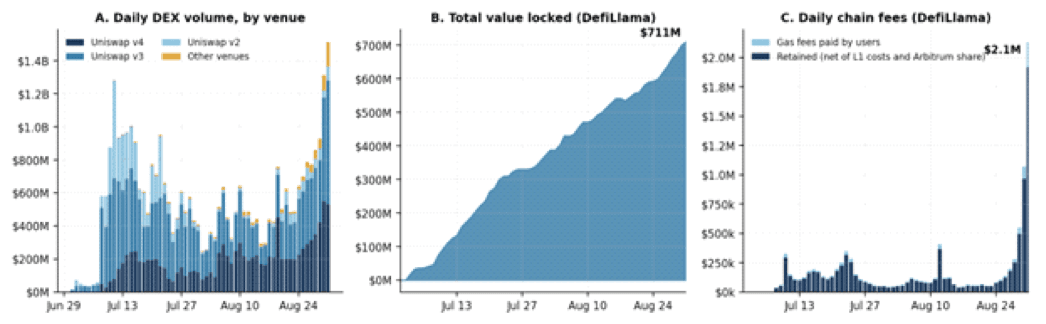
DEX volume ran at a few hundred million dollars a day through July and most of August, then climbed through the last week to $1.5 billion on August 31, almost all of it on Uniswap, while TVL doubled over August to $711 million (see exhibit 1). The third panel is what the chain earns: gas fees were $3.6 million in July and $6.6 million in August, most of it in the final week, when daily fees went from $105,000 on August 25 to $2.1 million on August 31. Robinhood runs the sequencer and keeps about 90% of that, after Ethereum settlement costs of roughly $20,000 for the month and a 10% licence share payable to the Arbitrum DAO, leaving it $6.0 million for August.
Exhibit 1: Robinhood Chain’s key metrics are impressive despite being only 2 months old
Source: Spartan Capital, Dune, Defillama
Against the brokerage, that is still small: Robinhood reported $1.31 billion of revenue and $573 million of net income for the second quarter, with crypto transaction revenue of $100 million, down 38% from a year earlier, so August's chain revenue is under half a percent of a quarter's top line. The exit rate is a different matter. The August 31 take of $1.9 million a day annualizes to about $700 million, and the first eight days of September brought in $24.8 million net, a quarter of what the entire crypto business earned in Q2 2026. Part of that is congestion pricing and will not hold, but the chain has become a line that sell-side analysts now model, and Robinhood's incentive to keep feeding it with listings, subsidies and product has grown with it.
Three things sit behind those panels, and the rest of the piece takes them one at a time: Robinhood Earn, which holds the deposits; the memecoin launchpads, which generate the trading and most of the fees; and Stock Tokens (debt securities issued by Robinhood Assets that track a stock's price without conferring ownership), which is where the two meet.
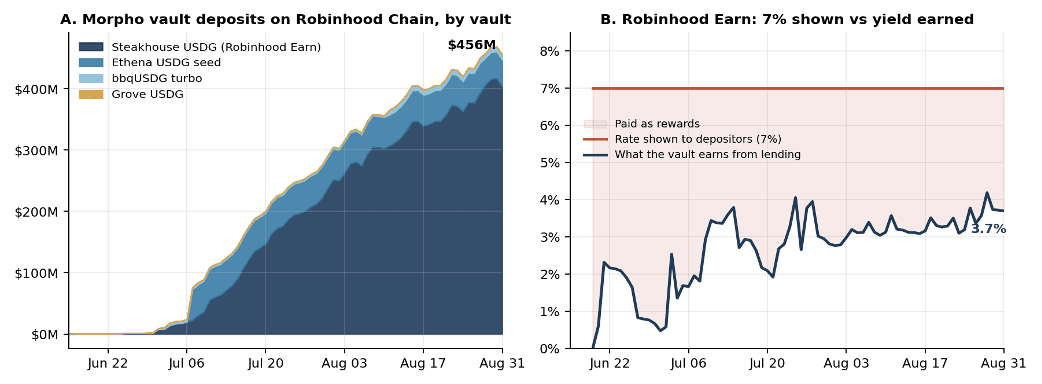
Robinhood Earn is simple. A US customer buys USDG, Paxos's dollar stablecoin, in the Robinhood app and lends it out, with no lockup and no fee, into a single Morpho vault on Robinhood Chain run by Steakhouse Financial, which lends to borrowers posting other yield-bearing dollars as collateral, mostly Ethena's USDe. Deposits scaled fast: from $9.5 million on July 1 to $456 million on August 31, 68% of the chain's TVL at month end (see exhibit 2). The depositor sees an estimated 7% APY, but the lending itself earned 3.7% at the end of August. The difference is paid as rewards, funded by Morpho and its lending partners for the first year in return for the borrow demand and the distribution Robinhood brings, roughly $14 million a year at the August 31 balance, and it ends once Robinhood users have $1.5 billion in the vault.
Exhibit 2: Deposits on Robinhood Chain have scaled quickly
Source: Spartan Capital, Dune
The trading activity, in contrast, comes from a different crowd. Solana's trading terminals (GMGN, Axiom, Pump.fun, Fomo, BasedBot) added Robinhood Chain within days of launch and routed $2.8 billion of swaps to it in August, about 16% of the chain's DEX volume. Memecoin swaps were 23% of August transactions on the chain; Stock Token swaps were 6.5%. It is also why Uniswap v4's share of DEX volume rose from 20% in July to 43% in August: v4 hooks let a launchpad attach its own logic to every pool it creates, and Pons, the chain's largest launchpad, uses one to collect fees, pay creators in ETH and let a token launch with a tokenized stock as its trading pair. Over 340,000 tokens had launched on the chain by the end of August, and app fees were $114 million for the month against $6.6 million of gas, so most of the value created on Robinhood Chain still accrues to the protocols on it rather than to Robinhood.
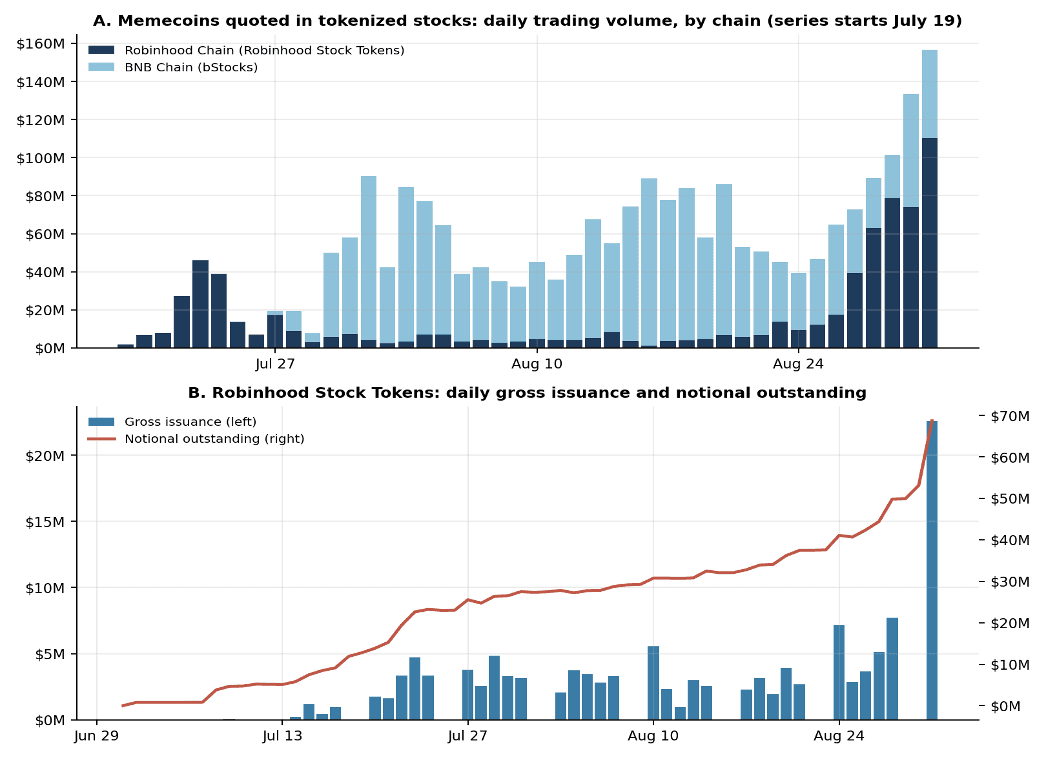
Where this launchpad economy meets Robinhood's stock product is the memecoin whose trading pair is a tokenized stock rather than ETH or a stablecoin. Counted on one definition across chains (one leg a launchpad memecoin, the other a factory-issued tokenized stock), that lane on Robinhood Chain went from under $5 million a day on Aug 19 to $110 million by Aug 31, surpassing BNB Chain's bStock-quoted memes on Aug 27. For the month, memes quoted in Robinhood Stock Tokens traded $518 million, up from $192 million in the second half of July. That demand in turn pulls on Stock Token supply. A memecoin quoted in HIMS or SPY needs HIMS or SPY tokens on the other side of every trade, and the only source of new Stock Tokens is issuance by Robinhood Assets against the underlying shares. The bottom of Chart 3 shows the response: notional supply outstanding went from $27 million on August 1 to $112 million by September 3, with $22.5 million issued on August 31 alone.
That growth has made Robinhood the fastest-growing tokenized-equity issuer in August. Stock Token supply rose 155% over the month against about 20% for xStocks and 2% for Ondo, and the holder base is the most retail-oriented in the category, 231,000 wallets holding an average of about $300 each against $970 for bStocks, $5,200 for xStocks and $7,600 for Ondo. The other retail-scale product is bStocks, with 559,000 holders on $544 million, built through Binance's August campaign of waived maker fees and trading rewards and through the direct exchange leg Robinhood Chain does not yet have. Both grew in August while the treasury-type issuers barely moved.
Exhibit 3: Memecoin trading volume on Robinhood Chain has overtaken BNB Chain
Source: Spartan Capital, Dune
Robinhood has engaged with the memecoin interest, listing CASHCAT, the chain's first breakout memecoin, in its US app on August 6. Three caveats apply to the August numbers: 1) the TVL is mostly one product whose headline rate is about half incentives; 2) part of the trading was incentive-driven (Robinhood covers gas on swaps inside its own wallet until September 29 and the late-August fee surge owed as much to congestion pricing and a handful of heavy wallets as to new users); and 3) the Stock Token lane is small in absolute terms and tied to the launchpad cycle rather than to demand for equity exposure.
Above all, everything in these charts was produced by a crypto-native user base. The Earn depositors are Robinhood customers, but the traders behind the DEX volume, the launchpads and the Stock Token pairs came from Solana's terminals, and they are the crowd that moves on to the next venue or ecosystem when the incentives or the momentum do. The gas subsidy ends on September 29, the launchpad cycle will cool at some point, and the 7% on Earn is scheduled to step down. What would change the picture is the arrival of Robinhood's own retail base, and that has not happened: the brokerage app is not connected to the chain, Stock Tokens are not sold to US customers, and Robinhood has given no timeline for either. Whether what Robinhood Chain has built in two months becomes a sustainable revenue stream depends on the 27 million accounts the chain was built for, and September will be another month of waiting for them.
Robinhood Chain went live on mainnet on July 1, 2026, a permissionless, EVM-compatible Layer 2 built on Arbitrum Orbit and settling to Ethereum, with ETH as gas and 100 millisecond blocks. Two protocols were live from day one and define what the chain does: Uniswap, the chain's main liquidity venue, and Morpho, which powers Robinhood Earn, the lending product launched with it. The pitch to developers was distribution: Robinhood has 27 million funded accounts and it intends to move them onchain over time, although that has not happened yet. While it is only 2 months old, and Robinhood’s traditional user base is not yet onchain, Robinhood Chain already ranks as the number 1 layer 2 chain by chain fees and DEX volumes and number 3 based on TVL.
DEX volume ran at a few hundred million dollars a day through July and most of August, then climbed through the last week to $1.5 billion on August 31, almost all of it on Uniswap, while TVL doubled over August to $711 million (see exhibit 1). The third panel is what the chain earns: gas fees were $3.6 million in July and $6.6 million in August, most of it in the final week, when daily fees went from $105,000 on August 25 to $2.1 million on August 31. Robinhood runs the sequencer and keeps about 90% of that, after Ethereum settlement costs of roughly $20,000 for the month and a 10% licence share payable to the Arbitrum DAO, leaving it $6.0 million for August.
Exhibit 1: Robinhood Chain’s key metrics are impressive despite being only 2 months old
Source: Spartan Capital, Dune, Defillama
Against the brokerage, that is still small: Robinhood reported $1.31 billion of revenue and $573 million of net income for the second quarter, with crypto transaction revenue of $100 million, down 38% from a year earlier, so August's chain revenue is under half a percent of a quarter's top line. The exit rate is a different matter. The August 31 take of $1.9 million a day annualizes to about $700 million, and the first eight days of September brought in $24.8 million net, a quarter of what the entire crypto business earned in Q2 2026. Part of that is congestion pricing and will not hold, but the chain has become a line that sell-side analysts now model, and Robinhood's incentive to keep feeding it with listings, subsidies and product has grown with it.
Three things sit behind those panels, and the rest of the piece takes them one at a time: Robinhood Earn, which holds the deposits; the memecoin launchpads, which generate the trading and most of the fees; and Stock Tokens (debt securities issued by Robinhood Assets that track a stock's price without conferring ownership), which is where the two meet.
Robinhood Earn is simple. A US customer buys USDG, Paxos's dollar stablecoin, in the Robinhood app and lends it out, with no lockup and no fee, into a single Morpho vault on Robinhood Chain run by Steakhouse Financial, which lends to borrowers posting other yield-bearing dollars as collateral, mostly Ethena's USDe. Deposits scaled fast: from $9.5 million on July 1 to $456 million on August 31, 68% of the chain's TVL at month end (see exhibit 2). The depositor sees an estimated 7% APY, but the lending itself earned 3.7% at the end of August. The difference is paid as rewards, funded by Morpho and its lending partners for the first year in return for the borrow demand and the distribution Robinhood brings, roughly $14 million a year at the August 31 balance, and it ends once Robinhood users have $1.5 billion in the vault.
Exhibit 2: Deposits on Robinhood Chain have scaled quickly
Source: Spartan Capital, Dune
The trading activity, in contrast, comes from a different crowd. Solana's trading terminals (GMGN, Axiom, Pump.fun, Fomo, BasedBot) added Robinhood Chain within days of launch and routed $2.8 billion of swaps to it in August, about 16% of the chain's DEX volume. Memecoin swaps were 23% of August transactions on the chain; Stock Token swaps were 6.5%. It is also why Uniswap v4's share of DEX volume rose from 20% in July to 43% in August: v4 hooks let a launchpad attach its own logic to every pool it creates, and Pons, the chain's largest launchpad, uses one to collect fees, pay creators in ETH and let a token launch with a tokenized stock as its trading pair. Over 340,000 tokens had launched on the chain by the end of August, and app fees were $114 million for the month against $6.6 million of gas, so most of the value created on Robinhood Chain still accrues to the protocols on it rather than to Robinhood.
Where this launchpad economy meets Robinhood's stock product is the memecoin whose trading pair is a tokenized stock rather than ETH or a stablecoin. Counted on one definition across chains (one leg a launchpad memecoin, the other a factory-issued tokenized stock), that lane on Robinhood Chain went from under $5 million a day on Aug 19 to $110 million by Aug 31, surpassing BNB Chain's bStock-quoted memes on Aug 27. For the month, memes quoted in Robinhood Stock Tokens traded $518 million, up from $192 million in the second half of July. That demand in turn pulls on Stock Token supply. A memecoin quoted in HIMS or SPY needs HIMS or SPY tokens on the other side of every trade, and the only source of new Stock Tokens is issuance by Robinhood Assets against the underlying shares. The bottom of Chart 3 shows the response: notional supply outstanding went from $27 million on August 1 to $112 million by September 3, with $22.5 million issued on August 31 alone.
That growth has made Robinhood the fastest-growing tokenized-equity issuer in August. Stock Token supply rose 155% over the month against about 20% for xStocks and 2% for Ondo, and the holder base is the most retail-oriented in the category, 231,000 wallets holding an average of about $300 each against $970 for bStocks, $5,200 for xStocks and $7,600 for Ondo. The other retail-scale product is bStocks, with 559,000 holders on $544 million, built through Binance's August campaign of waived maker fees and trading rewards and through the direct exchange leg Robinhood Chain does not yet have. Both grew in August while the treasury-type issuers barely moved.
Exhibit 3: Memecoin trading volume on Robinhood Chain has overtaken BNB Chain
Source: Spartan Capital, Dune
Robinhood has engaged with the memecoin interest, listing CASHCAT, the chain's first breakout memecoin, in its US app on August 6. Three caveats apply to the August numbers: 1) the TVL is mostly one product whose headline rate is about half incentives; 2) part of the trading was incentive-driven (Robinhood covers gas on swaps inside its own wallet until September 29 and the late-August fee surge owed as much to congestion pricing and a handful of heavy wallets as to new users); and 3) the Stock Token lane is small in absolute terms and tied to the launchpad cycle rather than to demand for equity exposure.
Above all, everything in these charts was produced by a crypto-native user base. The Earn depositors are Robinhood customers, but the traders behind the DEX volume, the launchpads and the Stock Token pairs came from Solana's terminals, and they are the crowd that moves on to the next venue or ecosystem when the incentives or the momentum do. The gas subsidy ends on September 29, the launchpad cycle will cool at some point, and the 7% on Earn is scheduled to step down. What would change the picture is the arrival of Robinhood's own retail base, and that has not happened: the brokerage app is not connected to the chain, Stock Tokens are not sold to US customers, and Robinhood has given no timeline for either. Whether what Robinhood Chain has built in two months becomes a sustainable revenue stream depends on the 27 million accounts the chain was built for, and September will be another month of waiting for them.
To learn more about investment opportunities with Spartan Capital, please contact ir@spartangroup.io
