Tokenized Equities and HIP-3: Bringing Stocks Onchain
By
José Sanchez, Kelvin Koh
Feb 23, 2026
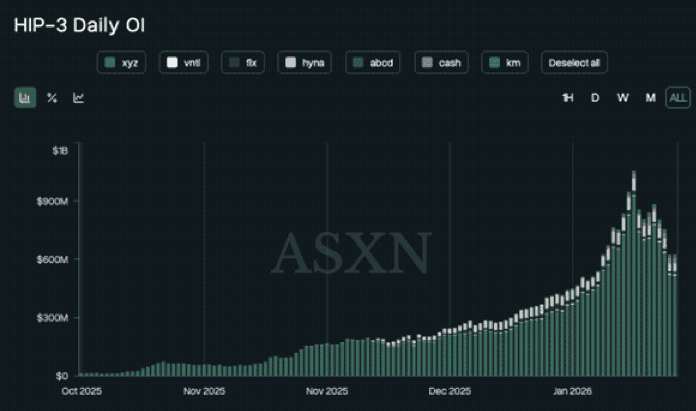
One of the most important developments in crypto over the past few months is the emergence of traditional asset trading on decentralized venues. The Hyperliquid Improvement Protocol 3 (HIP-3) upgrade, which went live on mainnet in October 2025, was the primary catalyst. What started as a niche experiment has rapidly scaled into a category with $56 billion in cumulative trading volume, over $600 million in open interest, and more than $6 million in total fees, all transparently onchain.
Trading of traditional assets onchain has risen meaningfully
Source: ASXN
Perpetual futures have dominated crypto derivatives for years, and extending this model to equities, commodities, and foreign exchange (fx) markets addresses a clear unmet demand. A significant portion of worldwide interest in US equities originates outside the United States, yet access remains gated by brokerage barriers, limited trading hours, and legacy settlement infrastructure. Onchain perpetual swaps solve this by offering 24/7 access, self-custodial execution, and near-instant settlement, without requiring a brokerage account. The infrastructure has matured in parallel: oracle networks now deliver licensed, real-time equity price feeds during market hours, while HIP-3 deployers have implemented bounded internal pricing mechanisms for weekends, ensuring hedged positions face no liquidation risk until markets reopen.
The regulatory environment further favours decentralized venues. Overlapping jurisdictional requirements between the CFTC and SEC make it structurally difficult for domestic incumbents to offer single-stock perpetual products to US retail investors. Platforms like Hyperliquid operate permissionlessly, serving a predominantly non-US user base for whom onchain perpetual swaps offer leveraged exposure, round-the-clock availability, and self-custodial execution without intermediary dependency. Compliant onshore products will eventually emerge, but in the interim, decentralized venues remain the primary beneficiaries of this structural gap.
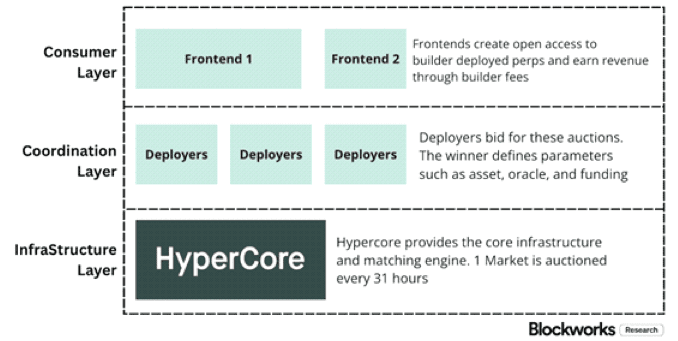
HIP-3 also represents Hyperliquid's evolution from a vertical exchange into a settlement infrastructure layer. The upgrade allows any deployer who stakes 500,000 HYPE tokens to permissionlessly launch perpetual futures markets on HyperCore, inheriting the platform's high-performance orderbook, margining engine, and distribution network. Deployers control market design, oracle configuration, and risk parameters, while earning 50% of the trading fees generated.
Hyperliquid has evolved from a vertical exchange into a settlement infrastructure layer
Source: Blockworks research
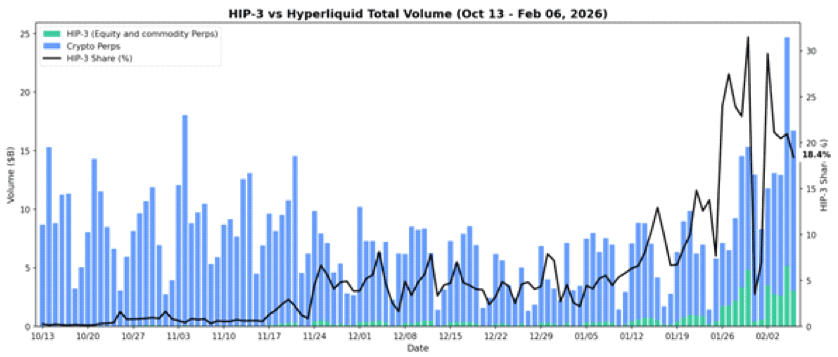
Competitive dynamics have consolidated rapidly: Trade.XYZ commands roughly 90% of HIP-3 volume, having won the first auctions for major stock tickers such as TSLA, NVDA, AAPL, META, and MSFT. Beyond equities, HIP-3 markets now span commodities and FX. The recent precious metals rally drove open interest to nearly $800 million from $260 million in a single month, and TradFi instruments account for approximately 20% of Hyperliquid's total venue volume on some days, with daily notional exceeding $5 billion.
Equity and commodity perps share of total crypto perps market has risen
Source: Spartan Capital
Outside HIP-3, Ostium has carved out a distinct position as a peer-to-pool exchange on Arbitrum, raising $24 million in December 2025 co-led by General Catalyst and Jump Crypto at a $250 million valuation. Ostium’s model quotes directly from offchain liquidity venues, offering traders direct oracle pricing and predictable SOFR-based holding costs rather than volatile funding rates. However, the model mandates trading-hour restrictions—no weekend activity—and depends on active offchain hedging, which limits scalability beyond what its TVL can support.
Solana represents a structurally different opportunity. As the dominant chain for tokenised spot equities, it hosts Backed’s xStocks, where over 60 tokenized US stocks and ETFs has been launched with approximately $186 million in AUM as of late 2025. Kraken’s acquisition of Backed, combined with existing integrations across DeFi protocols such as Jupiter, Kamino, and Raydium, positions Solana as the natural venue where spot tokenised equities could serve as both the oracle reference and collateral for perpetual swap contracts. If a Solana-native perpetual swap protocol successfully integrates xStocks as collateral for delta-neutral carry trades, it would bypass the legacy hedging frictions that currently constrain all other equity perpetual swap designs. This remains a latent architectural advantage rather than an immediate competitive threat, but it is the most compelling long-term alternative to HIP-3’s dominance.
The broader trajectory is clear. Just as stablecoins brought dollars onchain and prediction markets brought event contracts onchain, equity perpetual swaps are bringing stock market exposure onchain. The regulatory asymmetry that currently favours decentralized venues will not persist indefinitely, but the infrastructure being built now will form the foundation regardless of how the regulatory landscape evolves. This is one of the most consequential expansions of crypto's addressable market, and activity should continue growing through 2026.
One of the most important developments in crypto over the past few months is the emergence of traditional asset trading on decentralized venues. The Hyperliquid Improvement Protocol 3 (HIP-3) upgrade, which went live on mainnet in October 2025, was the primary catalyst. What started as a niche experiment has rapidly scaled into a category with $56 billion in cumulative trading volume, over $600 million in open interest, and more than $6 million in total fees, all transparently onchain.
Trading of traditional assets onchain has risen meaningfully
Source: ASXN
Perpetual futures have dominated crypto derivatives for years, and extending this model to equities, commodities, and foreign exchange (fx) markets addresses a clear unmet demand. A significant portion of worldwide interest in US equities originates outside the United States, yet access remains gated by brokerage barriers, limited trading hours, and legacy settlement infrastructure. Onchain perpetual swaps solve this by offering 24/7 access, self-custodial execution, and near-instant settlement, without requiring a brokerage account. The infrastructure has matured in parallel: oracle networks now deliver licensed, real-time equity price feeds during market hours, while HIP-3 deployers have implemented bounded internal pricing mechanisms for weekends, ensuring hedged positions face no liquidation risk until markets reopen.
The regulatory environment further favours decentralized venues. Overlapping jurisdictional requirements between the CFTC and SEC make it structurally difficult for domestic incumbents to offer single-stock perpetual products to US retail investors. Platforms like Hyperliquid operate permissionlessly, serving a predominantly non-US user base for whom onchain perpetual swaps offer leveraged exposure, round-the-clock availability, and self-custodial execution without intermediary dependency. Compliant onshore products will eventually emerge, but in the interim, decentralized venues remain the primary beneficiaries of this structural gap.
HIP-3 also represents Hyperliquid's evolution from a vertical exchange into a settlement infrastructure layer. The upgrade allows any deployer who stakes 500,000 HYPE tokens to permissionlessly launch perpetual futures markets on HyperCore, inheriting the platform's high-performance orderbook, margining engine, and distribution network. Deployers control market design, oracle configuration, and risk parameters, while earning 50% of the trading fees generated.
Hyperliquid has evolved from a vertical exchange into a settlement infrastructure layer
Source: Blockworks research
Competitive dynamics have consolidated rapidly: Trade.XYZ commands roughly 90% of HIP-3 volume, having won the first auctions for major stock tickers such as TSLA, NVDA, AAPL, META, and MSFT. Beyond equities, HIP-3 markets now span commodities and FX. The recent precious metals rally drove open interest to nearly $800 million from $260 million in a single month, and TradFi instruments account for approximately 20% of Hyperliquid's total venue volume on some days, with daily notional exceeding $5 billion.
Equity and commodity perps share of total crypto perps market has risen
Source: Spartan Capital
Outside HIP-3, Ostium has carved out a distinct position as a peer-to-pool exchange on Arbitrum, raising $24 million in December 2025 co-led by General Catalyst and Jump Crypto at a $250 million valuation. Ostium’s model quotes directly from offchain liquidity venues, offering traders direct oracle pricing and predictable SOFR-based holding costs rather than volatile funding rates. However, the model mandates trading-hour restrictions—no weekend activity—and depends on active offchain hedging, which limits scalability beyond what its TVL can support.
Solana represents a structurally different opportunity. As the dominant chain for tokenised spot equities, it hosts Backed’s xStocks, where over 60 tokenized US stocks and ETFs has been launched with approximately $186 million in AUM as of late 2025. Kraken’s acquisition of Backed, combined with existing integrations across DeFi protocols such as Jupiter, Kamino, and Raydium, positions Solana as the natural venue where spot tokenised equities could serve as both the oracle reference and collateral for perpetual swap contracts. If a Solana-native perpetual swap protocol successfully integrates xStocks as collateral for delta-neutral carry trades, it would bypass the legacy hedging frictions that currently constrain all other equity perpetual swap designs. This remains a latent architectural advantage rather than an immediate competitive threat, but it is the most compelling long-term alternative to HIP-3’s dominance.
The broader trajectory is clear. Just as stablecoins brought dollars onchain and prediction markets brought event contracts onchain, equity perpetual swaps are bringing stock market exposure onchain. The regulatory asymmetry that currently favours decentralized venues will not persist indefinitely, but the infrastructure being built now will form the foundation regardless of how the regulatory landscape evolves. This is one of the most consequential expansions of crypto's addressable market, and activity should continue growing through 2026.
To learn more about investment opportunities with Spartan Capital, please contact ir@spartangroup.io
