Venice: The Gateway to Intelligence
By
Patrick Forster, Kelvin Koh
Aug 19, 2026
In a world where every AI interaction is logged, analyzed, and potentially monetized, one platform made a radical bet. What if AI could be powerful and private at the same time? That platform is Venice AI. Venice was engineered from the ground up as a privacy-first alternative to mainstream AI assistants like ChatGPT, Claude, and Gemini. Its core conviction is simple but disruptive: users should be able to harness the power of state-of-the-art AI without surrendering their data to centralized servers.
Launched in May 2024 by Erik Voorhees — founder and former CEO of ShapeShift — Venice is a generative AI platform designed from the ground up around privacy, uncensored access, and a tokenized model for paying for inference. Voorhees is a well-known Bitcoin OG and a longtime advocate for privacy. Voorhees has been direct about what motivated the project. He observed the AI industry consolidates large tech companies with close government relationships, and that concerned him. The response was a platform that separates three things mainstream AI conflates: who controls the model, how access is paid for, and what users are allowed to do with it.
Venice AI is a private, multimodal AI platform that aggregates leading open-source and proprietary large language models under a single, privacy-protected interface. Rather than building a single proprietary model, Venice acts as a model router and inference layer. That gives users access to the best available models while ensuring their conversations are never persisted on Venice’s servers.
The platform’s defining characteristic is its zero-retention privacy architecture. When a user submits a prompt, it travels via SSL-encrypted connection through Venice’s proxy to a pool of GPU inference providers. The response streams directly back to the user’s browser without being stored anywhere on Venice’s infrastructure. Chat history lives exclusively in the user’s local browser storage. This approach stands in stark contrast to mainstream AI platforms, nearly all of which retain user conversation data on central servers — data that can be accessed internally, shared with third parties, or exposed through security breaches.
Venice offers users four privacy modes:
Anonymous - User identity is obscured, though model providers may still retain prompts.
Private - Uses zero-data-retention infrastructure and contractual privacy protections.
TEE (Trusted Execution Environment) - Employs hardware-isolated environments for additional security.
E2EE (End-to-End Encryption) - Prompts are encrypted on the user's device and only decrypted within verified secure environments.
These privacy options are designed to give users flexibility between convenience, model access, and security requirements.
Venice offers a broad range of AI-powered capabilities:
AI chat and text generation; 2. Image generation and editing; 3. Video creation; 4. Audio and music generation; 5. Coding assistance; 6. Web search integration; 7. OpenAI-compatible developer APIs; 8. Custom AI characters and workflows
The platform supports numerous AI models from providers and open-source communities, allowing users to choose models optimized for reasoning, coding, creative writing, image generation, or other specialized tasks.
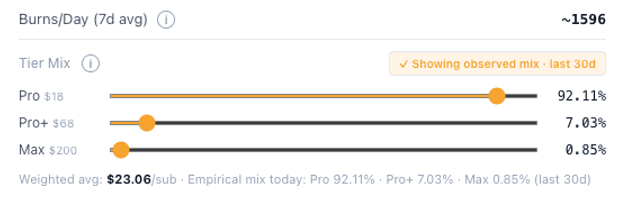
Venice monetizes through two complementary channels: subscriptions and API. The consumer subscription drives predictable, recurring revenue and based on estimates of available operating data likely generate gross margins of approximately 50%. Over the last 7 days, they attracted 1596 new subscribers per day, split across three available tiers: Pro ($18), Pro+ ($68), and Max ($200). Based on the observed mix from onchain burns, the weighted average subscription value (WASV) was $23.06.
Venice’s Pro plan is the most popular
Source: VeniceStats
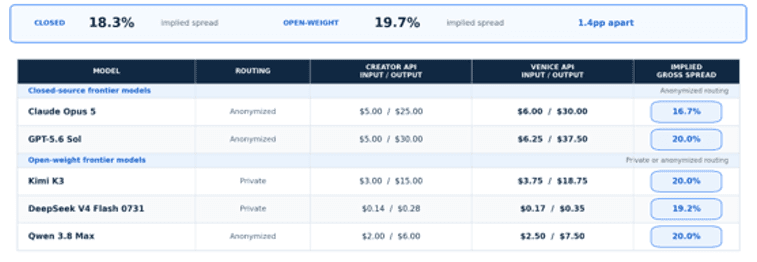
The Venice API allows developers to consume inference through whichever interface they would prefer, such as Hermes or Opencode. Pricing margin among both closed and open source models is broadly consistent around +20%. Video inference is an area which generates outsized credit revenue for Venice despite making up only a tiny fraction of requests. This is because video inference is much more compute intensive, and especially considering the privacy guarantees provided by Venice, could form a major growth opportunity for them in the future as models continue to improve and adoption increases.
Venice’s public price spreads are broadly similar across model types
Source: Venice, Anthropic, OpenAI, Moonshot AI, DeepSeek and Alibaba Cloud
Just two years in, the company already has more than 850,000 unique visitors to its website and serves more than 4 million active users and processes an average of 1.7 million API calls per day. The company is already profitable, with annualized run-rate revenues of over $100 million. Reflecting its success, Venice recently raised $65 million in a Series A round at a $1 billion valuation, announced on July 1, 2026 and led by crypto venture firm Dragonfly. This is the first outside capital the privacy-first AI startup has ever taken roughly two years after launch. Venice said the capital will go toward scaling its consumer app and API globally, with an explicit goal of extending access to "private, unrestricted intelligence" to more users and more AI agents. More concretely, the company plans to purchase its own GPUs and build out data centers, moving away from leased compute to cut costs and improve gross margins.
While impressive, Venice’s Series A fund raise created significant dissent from its users and existing token holders. Venice runs on a token economy: VVV is Venice’s native token. It functions as an access token rather than a payment token. When users stake VVV, they receive a daily allocation of Venice API inference capacity — covering text, image, and code generation — without paying per request.
That allocation is calculated as a pro-rata share of the platform’s total API capacity, based on each user’s share of VVV staked among active stakers. Users don’t spend VVV to make requests. They stake it, draw from their daily allocation as needed, and the allocation resets each day. Staked VVV also earns emissions-based yield, distributed according to demand on the Venice API.
Launched in August 2025, DIEM is a separate token representing perpetual AI inference. Each DIEM provides $1 per day of Venice API credit, indefinitely — a fixed daily compute allocation rather than usage-based pricing. DIEM can only be minted by locking staked VVV. While VVV is locked for minting, it continues to earn 80% of normal staking yield. Burning DIEM unlocks the original staked VVV at any time.
The essence of the controversy was: VVV token holders broadly believed they were pseudo-equity holders (a common trend among most tokens). Crucially, this did not mean they believed 100% of the value must go to the token. They understood that for the business to grow, capital must be reinvested by scaling infrastructure, marketing and other operating expenses. But what they believed was that the VVV token was the ultimate source of alignment, and this has since been challenged.
Venice drives value accrual to the VVV token in the following ways:
Discretionary revenue-funded burns (60%)
$2/$5/$10 of VVV bought and burned per new Pro/Pro+/Max subscription (21%)
5% of API-credit purchases buying and burning VVV (19%)
Annualizing the numbers for July, this comes to about $5.4 million. With VVV token’s current FDV of $1.1 billion, this implies a 204x buyback multiple, which is rich relative to other tokens that have a similar buyback mechanism. Conversely, compared with Venice’s annualized revenues of $70M, the revenue multiple is a more reasonable 18.5x, implying VVV token is currently valued as if 100% of the platform revenues accrue only to the token, rather than merely as an access token that derives only a small % of revenue from the platform. Post the Series A raise the token is secondary to the equity in all regards. Token holders have no claim on the company’s assets/treasury and have no governance rights. They also have no claim on the operating business, brand, software, data-centre infrastructure and all revenue not voluntarily transmitted to VVV.
Further, as a compute capital asset, VVV is a capital inefficient one. Minting 1 DIEM requires $6,283 of slVVV collateral whereas buying 1 DIEM in the open market costs $1,362. Buying DIEM is therefore 4.6x more capital-efficient for someone who simply wants compute. The slVVV collateral is recoverable and continues earning 80% of the normal staking yield (20% is taken by Venice), but is subject to price volatility. VVV emissions are also downtrending; annual issuance has fallen from 14 million tokens at launch to 3 million today and is scheduled to reach 2 million on 1st October. This means that the capital inefficiency of VVV looks only set to worsen as the mint breakeven time (the number of years until minting DIEM becomes cheaper than buying it) gets longer and longer. Overall, this reinforces the idea that VVV is a difficult and complex asset to value, but one that benefits from the lack of credible, liquid tokens for investors seeking exposure to the exponential growth of AI inference consumption.
Notwithstanding the controversy surrounding Venice’s Series A fund raise, no one can deny that Venice has been one of the few successful crypto-adjacent AI startups. Venice represents something genuinely new in the AI landscape: a platform that refuses to treat privacy as a premium add-on and instead makes it the structural foundation of everything it builds.
In a world where every AI interaction is logged, analyzed, and potentially monetized, one platform made a radical bet. What if AI could be powerful and private at the same time? That platform is Venice AI. Venice was engineered from the ground up as a privacy-first alternative to mainstream AI assistants like ChatGPT, Claude, and Gemini. Its core conviction is simple but disruptive: users should be able to harness the power of state-of-the-art AI without surrendering their data to centralized servers.
Launched in May 2024 by Erik Voorhees — founder and former CEO of ShapeShift — Venice is a generative AI platform designed from the ground up around privacy, uncensored access, and a tokenized model for paying for inference. Voorhees is a well-known Bitcoin OG and a longtime advocate for privacy. Voorhees has been direct about what motivated the project. He observed the AI industry consolidates large tech companies with close government relationships, and that concerned him. The response was a platform that separates three things mainstream AI conflates: who controls the model, how access is paid for, and what users are allowed to do with it.
Venice AI is a private, multimodal AI platform that aggregates leading open-source and proprietary large language models under a single, privacy-protected interface. Rather than building a single proprietary model, Venice acts as a model router and inference layer. That gives users access to the best available models while ensuring their conversations are never persisted on Venice’s servers.
The platform’s defining characteristic is its zero-retention privacy architecture. When a user submits a prompt, it travels via SSL-encrypted connection through Venice’s proxy to a pool of GPU inference providers. The response streams directly back to the user’s browser without being stored anywhere on Venice’s infrastructure. Chat history lives exclusively in the user’s local browser storage. This approach stands in stark contrast to mainstream AI platforms, nearly all of which retain user conversation data on central servers — data that can be accessed internally, shared with third parties, or exposed through security breaches.
Venice offers users four privacy modes:
Anonymous - User identity is obscured, though model providers may still retain prompts.
Private - Uses zero-data-retention infrastructure and contractual privacy protections.
TEE (Trusted Execution Environment) - Employs hardware-isolated environments for additional security.
E2EE (End-to-End Encryption) - Prompts are encrypted on the user's device and only decrypted within verified secure environments.
These privacy options are designed to give users flexibility between convenience, model access, and security requirements.
Venice offers a broad range of AI-powered capabilities:
AI chat and text generation; 2. Image generation and editing; 3. Video creation; 4. Audio and music generation; 5. Coding assistance; 6. Web search integration; 7. OpenAI-compatible developer APIs; 8. Custom AI characters and workflows
The platform supports numerous AI models from providers and open-source communities, allowing users to choose models optimized for reasoning, coding, creative writing, image generation, or other specialized tasks.
Venice monetizes through two complementary channels: subscriptions and API. The consumer subscription drives predictable, recurring revenue and based on estimates of available operating data likely generate gross margins of approximately 50%. Over the last 7 days, they attracted 1596 new subscribers per day, split across three available tiers: Pro ($18), Pro+ ($68), and Max ($200). Based on the observed mix from onchain burns, the weighted average subscription value (WASV) was $23.06.
Venice’s Pro plan is the most popular
Source: VeniceStats
The Venice API allows developers to consume inference through whichever interface they would prefer, such as Hermes or Opencode. Pricing margin among both closed and open source models is broadly consistent around +20%. Video inference is an area which generates outsized credit revenue for Venice despite making up only a tiny fraction of requests. This is because video inference is much more compute intensive, and especially considering the privacy guarantees provided by Venice, could form a major growth opportunity for them in the future as models continue to improve and adoption increases.
Venice’s public price spreads are broadly similar across model types
Source: Venice, Anthropic, OpenAI, Moonshot AI, DeepSeek and Alibaba Cloud
Just two years in, the company already has more than 850,000 unique visitors to its website and serves more than 4 million active users and processes an average of 1.7 million API calls per day. The company is already profitable, with annualized run-rate revenues of over $100 million. Reflecting its success, Venice recently raised $65 million in a Series A round at a $1 billion valuation, announced on July 1, 2026 and led by crypto venture firm Dragonfly. This is the first outside capital the privacy-first AI startup has ever taken roughly two years after launch. Venice said the capital will go toward scaling its consumer app and API globally, with an explicit goal of extending access to "private, unrestricted intelligence" to more users and more AI agents. More concretely, the company plans to purchase its own GPUs and build out data centers, moving away from leased compute to cut costs and improve gross margins.
While impressive, Venice’s Series A fund raise created significant dissent from its users and existing token holders. Venice runs on a token economy: VVV is Venice’s native token. It functions as an access token rather than a payment token. When users stake VVV, they receive a daily allocation of Venice API inference capacity — covering text, image, and code generation — without paying per request.
That allocation is calculated as a pro-rata share of the platform’s total API capacity, based on each user’s share of VVV staked among active stakers. Users don’t spend VVV to make requests. They stake it, draw from their daily allocation as needed, and the allocation resets each day. Staked VVV also earns emissions-based yield, distributed according to demand on the Venice API.
Launched in August 2025, DIEM is a separate token representing perpetual AI inference. Each DIEM provides $1 per day of Venice API credit, indefinitely — a fixed daily compute allocation rather than usage-based pricing. DIEM can only be minted by locking staked VVV. While VVV is locked for minting, it continues to earn 80% of normal staking yield. Burning DIEM unlocks the original staked VVV at any time.
The essence of the controversy was: VVV token holders broadly believed they were pseudo-equity holders (a common trend among most tokens). Crucially, this did not mean they believed 100% of the value must go to the token. They understood that for the business to grow, capital must be reinvested by scaling infrastructure, marketing and other operating expenses. But what they believed was that the VVV token was the ultimate source of alignment, and this has since been challenged.
Venice drives value accrual to the VVV token in the following ways:
Discretionary revenue-funded burns (60%)
$2/$5/$10 of VVV bought and burned per new Pro/Pro+/Max subscription (21%)
5% of API-credit purchases buying and burning VVV (19%)
Annualizing the numbers for July, this comes to about $5.4 million. With VVV token’s current FDV of $1.1 billion, this implies a 204x buyback multiple, which is rich relative to other tokens that have a similar buyback mechanism. Conversely, compared with Venice’s annualized revenues of $70M, the revenue multiple is a more reasonable 18.5x, implying VVV token is currently valued as if 100% of the platform revenues accrue only to the token, rather than merely as an access token that derives only a small % of revenue from the platform. Post the Series A raise the token is secondary to the equity in all regards. Token holders have no claim on the company’s assets/treasury and have no governance rights. They also have no claim on the operating business, brand, software, data-centre infrastructure and all revenue not voluntarily transmitted to VVV.
Further, as a compute capital asset, VVV is a capital inefficient one. Minting 1 DIEM requires $6,283 of slVVV collateral whereas buying 1 DIEM in the open market costs $1,362. Buying DIEM is therefore 4.6x more capital-efficient for someone who simply wants compute. The slVVV collateral is recoverable and continues earning 80% of the normal staking yield (20% is taken by Venice), but is subject to price volatility. VVV emissions are also downtrending; annual issuance has fallen from 14 million tokens at launch to 3 million today and is scheduled to reach 2 million on 1st October. This means that the capital inefficiency of VVV looks only set to worsen as the mint breakeven time (the number of years until minting DIEM becomes cheaper than buying it) gets longer and longer. Overall, this reinforces the idea that VVV is a difficult and complex asset to value, but one that benefits from the lack of credible, liquid tokens for investors seeking exposure to the exponential growth of AI inference consumption.
Notwithstanding the controversy surrounding Venice’s Series A fund raise, no one can deny that Venice has been one of the few successful crypto-adjacent AI startups. Venice represents something genuinely new in the AI landscape: a platform that refuses to treat privacy as a premium add-on and instead makes it the structural foundation of everything it builds.
To learn more about investment opportunities with Spartan Capital, please contact ir@spartangroup.io
